
Dual-Brand SKF Timken Bearings for Pump & Compressor OEMs – Wholesale Supplier
Counterfeit bearings rarely fail immediately—they fail after installation, after commissioning, and after the warranty window closes.
To verify authenticity and source genuine SKF and Timken bearings for pumps and compressors, buyers must cross-check packaging security features against manufacturer databases, confirm the distributor’s authorization status through official brand portals, and validate country-of-origin markings against each brand’s current production footprint. A reliable dual-brand SKF Timken bearings wholesale supplier maintains direct traceability to authorized mills, provides batch-level documentation, and supports cross-reference interchange without compromising authenticity.
I still remember the first time I pulled apart a "genuine" Timken tapered roller bearing that had seized inside a process gas compressor. The outer ring was stamped correctly, the cage looked right, but the rollers were undersized and the raceway finish was visibly rough under a handheld loupe. The buyer—a mid-size chemical plant in Southeast Asia—had sourced through a broker who promised OEM pricing. Within weeks, vibration spiked, the shaft scored, and the entire rotor assembly needed replacement. The bearing itself cost a fraction of the total downtime loss. That compressor was down for weeks, not days. Since then, I have handled dozens of similar cases involving both SKF and Timken products, and the pattern is always the same: the counterfeit looks correct until it is under load. [NEED_CITE: SKF anti-counterfeit identification guide outlines packaging and marking verification steps]
The rest of this guide walks through exactly how to verify authenticity, how to cross-reference between brands when supply constraints hit, and how to choose a sourcing partner who will not put your production line at risk.
How Do You Verify SKF and Timken Bearing Authenticity on Arrival?
Authenticity verification starts at the outer packaging and ends with physical inspection of the bearing marking—every step must match the manufacturer’s current security protocol.
Both SKF and Timken have layered their anti-counterfeit measures across packaging, marking, and digital verification. The process is not a single check but a sequence, and skipping any step leaves a gap.
For SKF products, the current generation of packaging includes a holographic label with a unique QR code that links to SKF’s verification platform. Scanning the code should return a result confirming the product batch, the expected destination region, and whether the code has been scanned before. A first-time scan from a known authorized distributor’s shipment is expected; a code that has already been scanned multiple times from different IP addresses is a red flag. [NEED_CITE: SKF Authenticate app and QR code verification process for bearing products]
For Timken, the verification approach relies on a combination of packaging security features and direct engagement with Timken’s distributor verification team. Timken’s packaging includes tamper-evident seals, specific font and logo placement standards, and batch traceability codes. Buyers can submit these codes to Timken’s customer verification channel to confirm whether the batch matches an authorized shipment. [NEED_CITE: Timken brand protection program and distributor verification process]
Here is the step-by-step sequence I follow when inspecting incoming stock:
- Outer carton inspection: Check for consistent print quality, correct logo proportions, and intact tamper-evident tape. Reprinted cartons often have slightly off-color logos or blurred text.
- Inner packaging and labeling: SKF uses specific label formats with part numbers, batch codes, and country-of-origin markings. Timken uses a similar system but with different font standards and label placement. Compare against the manufacturer’s current published examples.
- Bearing marking verification: The part number, brand logo, and country-of-origin stamp on the bearing itself must match the packaging. Counterfeit bearings often have markings that are laser-etched rather than stamped, or the font spacing is inconsistent.
- Physical dimension spot-check: Use a micrometer to verify bore, outside diameter, and width against the manufacturer’s published tolerance table. Counterfeit bearings frequently fall outside standard tolerance bands. [NEED_CITE: ISO 492 standard defines radial bearing tolerance classes]
- Surface and material observation: Under magnification, genuine bearing raceways show a consistent superfinish pattern. Counterfeit raceways often display visible grinding marks or inconsistent surface texture.
A European MRO operator once sent me a set of SKF deep groove ball bearings that "felt wrong." The packaging looked correct at first glance, but the inner label used a font weight that was slightly too bold, and the QR code on the holographic sticker redirected to a generic logistics page rather than SKF’s verification domain. The bearings themselves had a faint grinding chatter visible on the outer ring raceway under a ten-power loupe. The operator had purchased from a marketplace seller offering prices well below authorized channel levels. The entire batch was rejected.

The key takeaway is that no single check is sufficient. Authenticity verification is a layered process, and a trustworthy SKF Timken bearings wholesale supplier will support every step rather than resist scrutiny.
Can You Cross-Reference SKF and Timken Bearings Without Risk?
Yes, cross-reference interchange between SKF and Timken is technically sound for most standard bearing types, provided the dimensional and load ratings match exactly and the replacement bearing comes from a verified source.
Cross-referencing is not a compromise—it is a standard engineering practice. Pump and compressor OEMs frequently face supply constraints on one brand and need to qualify an alternative without redesigning the housing or shaft. The interchange works because both SKF and Timken manufacture to the same ISO and ABMA dimensional standards. A SKF 6206 and a Timken 6206 share identical bore, outside diameter, and width dimensions. The internal geometry may differ slightly—contact angles, groove curvature, cage design—but for standard radial loads and speeds, the performance envelope overlaps.
The risk is not in the interchange itself but in the sourcing. When a buyer requests a Timken substitute for a specified SKF position, the substitute must be a genuine Timken bearing, not a no-name product stamped with a Timken part number. This is where the SKF Timken bearings wholesale supplier’s role becomes critical: the supplier must provide traceable proof that the substitute bearing came from Timken’s authorized production channel.
Here is how I approach cross-reference requests from OEM buyers:
- Confirm dimensional equivalence: Verify that bore, OD, width, and basic load ratings match between the original and proposed substitute. For tapered roller bearings, also confirm the contact angle and cage type.
- Check application-specific requirements: Some pump and compressor designs specify a particular brand’s internal geometry for high-speed or high-temperature operation. In these cases, interchange may require the OEM’s engineering approval.
- Validate the substitute’s origin: Request the substitute bearing’s country-of-origin marking and batch documentation. Confirm through the brand’s verification channel.
- Document the interchange: Maintain a record of the original specification, the substitute part number, the supplier’s authorization proof, and the verification result. This supports future audits and warranty claims.
A Middle East pump manufacturer once needed to switch from SKF to Timken for a series of end-suction process pumps due to lead time issues. The interchange was straightforward for the deep groove ball bearings and cylindrical roller bearings used in the pump ends. However, the thrust bearing arrangement required careful review because the original design relied on a specific SKF cage geometry that did not have a direct Timken equivalent. We worked with the OEM’s engineering team to qualify a Timken angular contact arrangement that met the same axial load and speed requirements. The qualification took weeks of testing, but the result was a fully validated interchange that kept production on schedule.
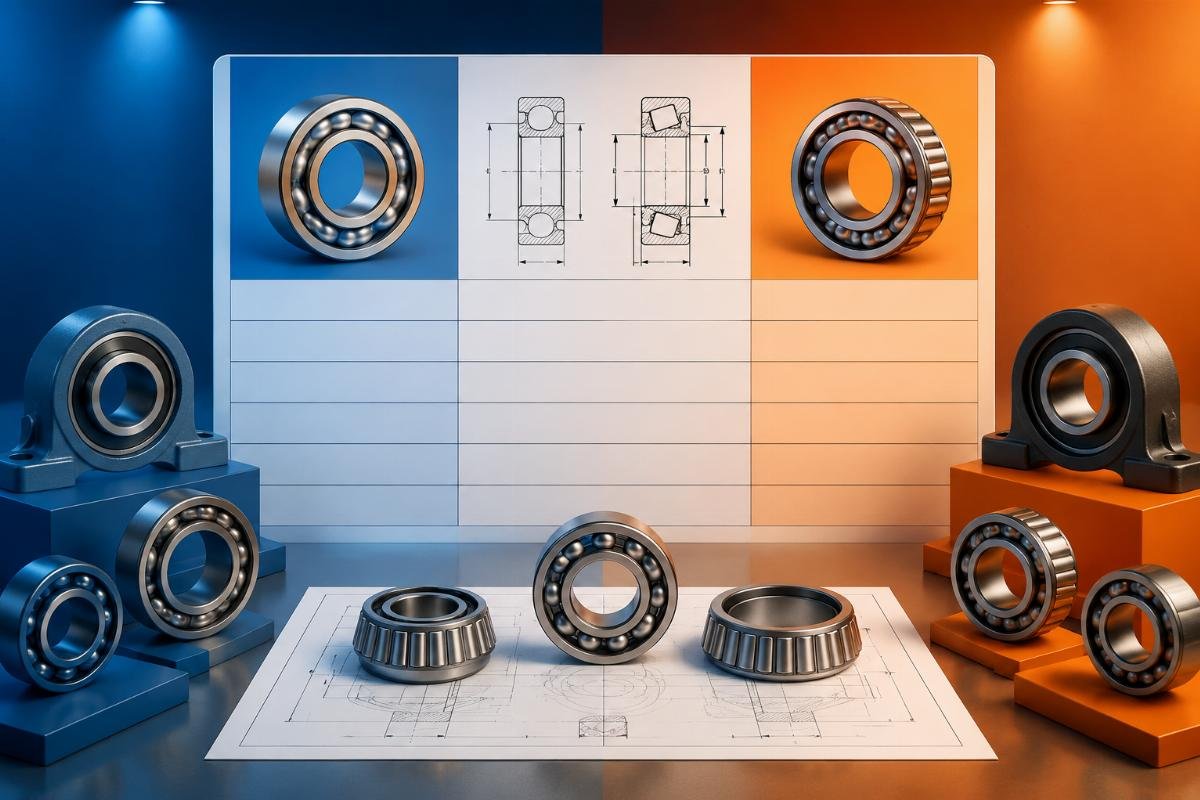
The principle is simple: interchange is an engineering decision, not a purchasing shortcut. A competent SKF Timken bearings wholesale supplier supports the engineering review rather than simply swapping part numbers.
What Should a Buyer Expect from a Dual-Brand Wholesale Supplier?
A dual-brand SKF Timken bearings wholesale supplier must provide verifiable authorization status, batch-level traceability, technical cross-reference support, and country-of-origin transparency—anything less is a sourcing risk.
The bearing market is flooded with intermediaries who claim to supply genuine products but cannot prove where the stock originated. Some source from gray-market channels where the bearing may be genuine but the storage conditions, handling, and documentation are uncontrolled. Others mix genuine and counterfeit stock, shipping authentic bearings for small sample orders and substituting counterfeits for production quantities. The buyer has no way to detect the switch until the bearing fails in the field.
When evaluating a SKF Timken bearings wholesale supplier, I focus on four verifiable criteria:
Authorization and traceability: The supplier should be able to demonstrate a direct purchasing relationship with SKF or Timken’s authorized distribution network. This does not necessarily mean the supplier is a brand-appointed distributor—it may be a tier-one dealer sourcing from an authorized master distributor—but the supply chain must be traceable back to the brand. [NEED_CITE: SKF and Timken authorized distributor network verification processes]
Documentation depth: For each shipment, the supplier should provide commercial invoices, packing lists, country-of-origin certificates, and—when available—mill test reports or batch-specific quality certificates. The documentation should match the physical markings on the bearing and packaging.
Technical support capability: A dual-brand supplier should maintain cross-reference databases covering the full product ranges of both SKF and Timken, including deep groove ball bearings, tapered roller bearings, spherical roller bearings, cylindrical roller bearings, angular contact bearings, and thrust bearings. The supplier’s technical team should be able to advise on interchange feasibility, application-specific selection, and tolerance class equivalence. [NEED_CITE: ABMA and ISO bearing dimensional standard frameworks]
Anti-counterfeit commitment: The supplier should actively support the buyer’s verification process, providing high-resolution images of packaging and markings before shipment, cooperating with brand verification checks, and standing behind the authenticity of every unit shipped. A supplier who resists verification requests is signaling a problem.
A Latin American distributor once approached me after receiving a shipment of Timken tapered roller bearings from a new supplier. The packaging looked correct, but the bearings’ country-of-origin markings did not match Timken’s known production facilities for that product line. The supplier could not provide any documentation beyond a commercial invoice. The distributor requested a refund, and the supplier disappeared. The entire shipment—multiple container loads—was unsellable. The distributor’s reputation with its own customers took years to rebuild.

The lesson is that the supplier’s willingness to be transparent is the strongest indicator of authenticity. A reliable SKF Timken bearings wholesale supplier treats verification as a service, not an inconvenience.
How Do Country-of-Origin Markings Help Identify Genuine Bearings?
Country-of-origin markings on SKF and Timken bearings are a critical authenticity indicator, but buyers must understand each brand’s current production footprint to interpret them correctly.
Both SKF and Timken operate manufacturing facilities across multiple countries, and the country-of-origin marking on a bearing reflects the factory where that specific unit was produced. Counterfeiters often get this wrong, stamping a country-of-origin that does not match the brand’s actual production locations for that product type.
SKF’s production network includes facilities in Sweden, Germany, France, Italy, China, India, Brazil, and other countries. The specific factory depends on the bearing type and size range. For example, SKF’s large spherical roller bearings for industrial gearboxes are often produced in European facilities, while certain deep groove ball bearings for the automotive aftermarket may come from Asian plants. [NEED_CITE: SKF global manufacturing facility locations and product line allocation]
Timken’s production footprint includes facilities in the United States, China, India, Poland, France, and other countries. Timken’s tapered roller bearings for automotive and industrial applications are produced across multiple plants, and the country-of-origin marking varies by product line and batch. [NEED_CITE: Timken global manufacturing network and facility product specialization]
The key for buyers is to know which countries are legitimate sources for the specific bearing type and size they are purchasing. If a supplier offers a Timken tapered roller bearing stamped with a country-of-origin that Timken does not use for that product line, the bearing is suspect. Similarly, if a SKF bearing’s country-of-origin marking does not align with SKF’s known production allocation for that type, the buyer should escalate the verification.
I once reviewed a batch of SKF spherical roller bearings offered by a Central Asian trader. The bearings were stamped with a country-of-origin that SKF does not use for spherical roller bearings in that size range. The trader insisted the stock was genuine, sourced from a "special channel." When I asked for the mill test report and the authorization chain, the trader could not provide either. The bearings were almost certainly counterfeit.

Country-of-origin verification is not foolproof—a sophisticated counterfeiter can replicate the correct marking—but it is a fast, low-cost filter that eliminates a significant portion of fake stock. A knowledgeable SKF Timken bearings wholesale supplier will proactively provide country-of-origin information and support the buyer’s verification process.
Conclusion
Authenticity verification, cross-reference interchange, and supplier transparency are not optional—they are the foundation of reliable bearing procurement for pump and compressor OEMs. A qualified SKF Timken bearings wholesale supplier supports every step of the process, from packaging inspection to batch traceability to technical interchange review. Buyers who invest in verification upfront avoid the far greater cost of field failures, production downtime, and reputational damage.
Leave a Reply