
SKF vs Timken Bearings for Mining Wheel Hubs | Wholesale Supplier
同型号不等于同品质——同一型号在不同产地、不同批次的保持架用料和游隙等级可能完全不同。
SKF and Timken bearings for mining equipment wheel hubs each dominate different performance dimensions: Timken’s tapered roller bearings excel in heavy-load shock resistance and case-hardened durability, while SKF’s solutions lead in advanced sealing systems and lubrication integration. Selecting between them requires more than cross-reference interchange — buyers must verify cage material suffixes, production origin codes, and seal configurations to match actual site conditions.
I still remember a shipment of tapered roller bearings bound for a copper mine in Chile. The buyer had specified a well-known Timken model for their haul truck wheel hubs. When the containers arrived, the mine’s maintenance supervisor ran his thumb along the cage and immediately called us — the cage felt different from the batch they had been running at their Australian operation. Same model number, same outer dimensions, but the cage material was not identical. It turned out that the manufacturer adjusts cage specifications for different regional markets, and we had to dig into production codes to confirm what was actually inside the box. [NEED_CITE: regional specification variation practices among major bearing manufacturers for mining applications] That moment reshaped how I approach every mining wheel hub bearing inquiry: the model number is only the starting point.

Whether you are replacing worn units on a dump truck or sourcing for a new fleet, understanding SKF vs Timken bearings for mining equipment wheel hubs at a deeper level saves downtime, avoids counterfeit traps, and prevents costly mismatched installations.
How Do SKF and Timken Bearing Designs Differ for Mining Wheel Hubs?
The core design philosophies diverge: Timken prioritizes load capacity and shock tolerance through its tapered roller geometry and case-hardening processes, while SKF emphasizes system-level performance through integrated sealing, optimized lubrication, and condition monitoring compatibility.
In mining wheel hub applications, bearings face extreme radial and axial loads, constant vibration, contaminant ingress from dust and slurry, and wide temperature swings. Both brands engineer for these conditions, but their approaches differ in meaningful ways.
| Design Dimension | Timken Tapered Roller Series | SKF Spherical Roller / Tapered Series |
|---|---|---|
| Primary Load Orientation | Combined radial-axial, optimized for heavy axial | Primarily radial with moderate axial, misalignment tolerance |
| Cage Material Options | Pressed steel standard; machined brass or polymer for select mining grades | Pressed steel standard; machined brass or fiber-reinforced polymer for high-temperature duty |
| Sealing Approach | Separate seal kits; hub design dependent | Integrated contact or non-contact seals available in sealed variants |
| Lubrication Integration | Grease-filled on request; open designs common for relubrication | Pre-lubricated sealed options; relubrication grooves in standard designs |
| Heat Treatment | Case-carburized for shock-prone applications | Through-hardened standard; case-carburized for select heavy-duty series |
| Misalignment Tolerance | Low — requires precise shaft and housing alignment | Higher — spherical roller designs accommodate shaft deflection |
[NEED_CITE: ISO 15243 damage classification and its relationship to bearing selection in heavy industry]
A European mining equipment OEM once asked us to evaluate whether switching from a Timken tapered roller setup to an SKF spherical roller design would reduce unplanned stoppages on their shovel wheel motors. The answer was not simple. The Timken configuration handled the axial thrust from inclined shafts better, but the SKF spherical roller design tolerated the slight shaft misalignment caused by thermal expansion in the housing. The final decision depended on whether the root cause of failure was overload-induced fatigue or misalignment-induced edge loading. [NEED_CITE: root cause distribution per ISO 15243]
For buyers comparing SKF vs Timken bearings for mining equipment wheel hubs, the takeaway is clear: match the bearing type to the dominant failure mode at your site, not just to the OEM catalog number.
Can Timken and SKF Bearing Models Be Directly Interchanged?
Cross-brand interchange is dimensionally possible in most cases, but functional interchange requires checking seal geometry, lubrication fill volume, internal clearance class, and cage type — not just bore, OD, and width.
Many procurement teams assume that if the basic dimensions match, the bearing drops right in. In mining wheel hubs, this assumption causes premature failures. Here is a practical interchange verification workflow:
- Confirm basic dimensions — bore diameter, outside diameter, and width must match per ISO 15 dimensional standards. [NEED_CITE: ISO 15 rolling bearing boundary dimensions]
- Check internal clearance class — mining wheel hubs typically require C3 or C4 clearance to accommodate thermal expansion. A C0 (standard) clearance bearing from one brand may bind when substituted into a hub designed for C4.
- Verify cage type and suffix — a pressed steel cage versus a machined brass cage changes the bearing’s maximum operating speed, temperature tolerance, and lubrication compatibility.
- Inspect seal or shield configuration — contact seals from one brand may have different lip geometry than another, affecting both sealing effectiveness and friction heat generation.
- Review lubrication fill quantity — pre-greased variants differ in fill volume and grease type. Overfilling a sealed hub bearing causes churning and overheating; underfilling accelerates wear.
- Examine chamfer and ring thickness — subtle differences in inner ring chamfer or outer ring thickness can affect fit and load distribution in the housing.

A distributor in West Africa received an order for SKF spherical roller bearings to replace worn units in vibrating screen wheel hubs on a gold mine. The OEM part number mapped cleanly to an SKF equivalent. But when the maintenance team installed them, the bearings ran noticeably hotter within the first week. Investigation revealed the original Timken units had been supplied with a specific high-temperature grease fill and a C4 clearance, while the SKF replacement arrived with standard grease and C3 clearance. The clearance mismatch caused internal preload under operating temperature, generating excess heat. [NEED_CITE: bearing internal clearance classes per ISO 5753]
When sourcing SKF vs Timken bearings for mining equipment wheel hubs through cross-reference, always request full suffix breakdowns from your supplier — not just the base model number.
Why Do Same-Model Bearings Feel Different Across Batches?
Production origin codes, cage material suffixes, and batch-specific heat treatment lots create real performance differences even within identical model numbers — and these differences are not always documented on the outer box.
This is perhaps the most counterintuitive lesson in mining bearing procurement. Two boxes of the same Timken tapered roller bearing, sitting side by side in a warehouse, can contain units with different cage materials, different internal clearance grades, or different production facility origins. The model number on the label stays the same. The performance in a重载 wheel hub does not.
Several factors drive this variation:
- Regional market specifications — manufacturers sometimes produce different cage variants for different geographic markets based on local availability of raw materials and regional demand patterns. A cage material optimized for one climate or duty cycle may behave differently in another.
- Production facility differences — a brand may operate multiple factories globally. While dimensional tolerances remain consistent, subtle differences in heat treatment atmosphere control or cage finishing processes can affect surface finish and long-term fatigue performance. [NEED_CITE: bearing manufacturing process variation impact on fatigue life per ISO 281]
- Batch code decoding — the production date code and batch identifier on the bearing ring or packaging encode information about the manufacturing lot. Experienced buyers learn to read these codes to confirm origin and production timeline.
- Specification updates — brands periodically update cage designs, seal materials, or grease formulations. A bearing produced last year may differ from one produced this month, even under the same model number.

I once worked with a Central Asian mining company that needed to replace a batch of worn wheel hub bearings on their haul trucks. They provided an OEM part number that mapped to a Timken tapered roller bearing. We sourced the exact model, verified the batch codes, and confirmed the cage type matched their existing fleet specification. But when we cross-referenced with an SKF equivalent for a backup order, we discovered the SKF version used a different cage design as standard — a machined brass cage where the Timken used a pressed steel cage. Both were technically correct for the application, but the mine’s maintenance team had a specific relubrication procedure calibrated for the pressed steel cage’s oil retention characteristics. Switching without adjusting the maintenance interval would have risked premature cage wear.
For buyers evaluating SKF vs Timken bearings for mining equipment wheel hubs, always confirm cage suffix, clearance class, and production origin before finalizing an order — even when the model number appears identical.
How Can Buyers Verify Authenticity of Mining Bearings?
Authenticity verification requires a multi-layer approach: QR code or app-based traceability checks, authorized distributor status confirmation, document chain completeness review, and physical inspection of packaging and marking quality.
The mining bearing market is heavily targeted by counterfeiters. Fake or refurbished bearings sold as genuine can fail catastrophically under heavy-load mining conditions — and the failure rate of counterfeit bearings in重载 applications is substantially higher than genuine units. [NEED_CITE: counterfeit bearing failure rate comparison in heavy industry applications]
A systematic verification process protects your investment:
- QR code and digital traceability — Both SKF and Timken have implemented QR code-based authentication systems. Scan the code on the bearing packaging using the brand’s official app to verify product authenticity, production date, and origin. [NEED_CITE: brand-specific anti-counterfeit digital verification programs]
- Authorized distributor verification — Confirm that your supplier holds current authorization from the brand. Authorized distributors maintain direct supply chains and can provide traceable documentation. Request the distributor’s authorization certificate and cross-check with the brand’s official dealer locator.
- Document chain review — Genuine bearing shipments include a complete document package: commercial invoice, packing list, certificate of conformity, and often a mill test certificate or batch-specific quality report. Missing or incomplete documentation is a red flag.
- Physical packaging inspection — Genuine packaging features high-quality printing, precise color matching, consistent font usage, and tamper-evident seals. Counterfeit packaging often shows slight color shifts, blurred text, or inconsistent labeling.
- Bearing marking quality — Examine the bearing ring markings. Genuine bearings have crisp, deeply etched model numbers, brand logos, and origin codes. Counterfeit markings often appear shallow, poorly aligned, or use incorrect font styles.
- Weight and dimension spot-check — Counterfeit bearings sometimes use inferior materials that result in weight deviations. A simple weight comparison against a known genuine unit can reveal discrepancies.
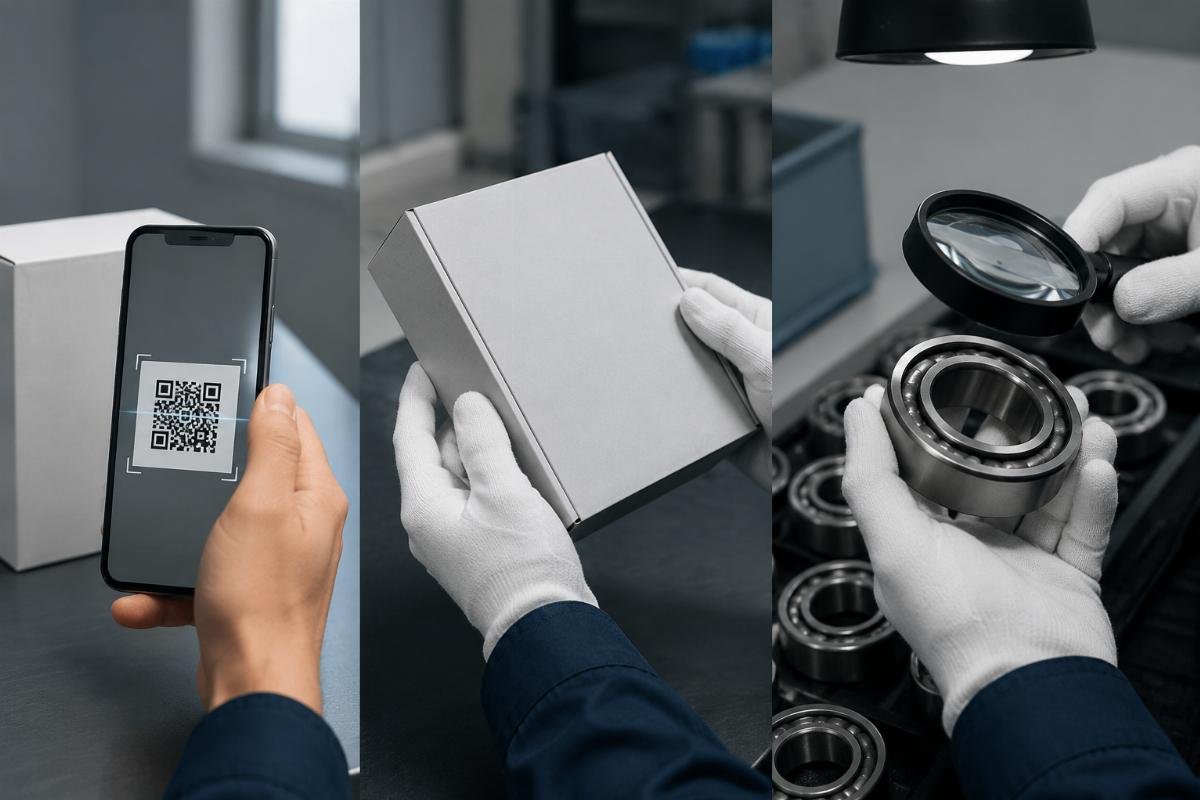
A steel mill in the Middle East purchased a batch of large spherical roller bearings for their continuous caster wheel hubs from an online marketplace at a price significantly below market rate. The bearings arrived in packaging that looked correct at first glance. But when the maintenance team opened the boxes, they noticed the bearing rings had a slightly different surface finish than their existing stock. The QR codes on the packaging scanned, but the verification app returned an error message indicating the codes had been scanned multiple times from different locations — a classic sign of cloned codes on counterfeit products. The mill halted installation, returned the bearings, and sourced replacements through an authorized channel. The cost of the fake bearings was lower, but the potential cost of a catastrophic wheel hub failure during continuous casting would have been orders of magnitude higher.
For buyers sourcing SKF vs Timken bearings for mining equipment wheel hubs, treat authenticity verification as a non-negotiable step in the procurement process — not an afterthought.
How Should Buyers Choose Between SKF and Timken for Specific Mining Conditions?
The choice between SKF and Timken depends on matching bearing design strengths to your specific operational parameters: load type, speed range, temperature environment, contamination exposure, and maintenance accessibility.
There is no universal "better" brand for mining wheel hubs. The right choice depends on your application’s dominant stressors. Here is a decision framework:
- Heavy shock loads and high axial thrust — Timken’s tapered roller bearings with case-carburized rings are engineered for these conditions. Haul truck wheel hubs, shovel swing circles, and dragline pivot points typically benefit from Timken’s shock-load design philosophy.
- Misalignment and shaft deflection — SKF’s spherical roller bearings accommodate angular misalignment, making them suitable for applications where shaft deflection or housing distortion is expected. Vibrating screens, conveyor pulley wheels, and some crusher roll assemblies often perform better with SKF spherical designs.
- High contamination environments — Both brands offer sealed variants, but SKF’s integrated seal designs and proprietary seal materials provide advanced protection against dust, slurry, and water ingress. Open-pit mining wheel hubs exposed to constant dust benefit from SKF’s sealing expertise.
- Elevated temperature operation — Both brands offer high-temperature variants with specialized heat treatment and high-temperature grease fills. Verify the specific temperature rating and grease compatibility for your operating range.
- Condition monitoring integration — SKF’s ecosystem includes integrated sensors and monitoring platforms that connect bearing condition data to maintenance systems. If your operation uses predictive maintenance, SKF’s monitoring compatibility may offer operational advantages.

A copper mine in South America operates a fleet of haul trucks in high-altitude conditions with extreme temperature swings between day and night. Their wheel hubs experience heavy radial loads, moderate axial thrust, and significant thermal cycling. After analyzing failure patterns, their engineering team determined that the dominant failure mode was fatigue spalling initiated by edge loading due to thermal-induced misalignment. They switched from a standard tapered roller design to an SKF spherical roller bearing with C4 clearance and integrated contact seals. The result was a meaningful extension in bearing service life and a reduction in unplanned wheel hub replacements. [NEED_CITE: bearing fatigue life adjustment factors per ISO 281]
Conversely, an iron ore mine in Western Australia operates dump trucks with heavily loaded wheel hubs experiencing extreme shock loads from rough haul roads. Their engineering team specified Timken tapered roller bearings with case-carburized rings and pressed steel cages, optimized for shock resistance and axial load capacity. The bearing selection matched the dominant stress profile, and the fleet achieved consistent service intervals.
For buyers comparing SKF vs Timken bearings for mining equipment wheel hubs, the decision should be driven by application-specific failure mode analysis, not brand preference or price alone.
Conclusion
Selecting between SKF and Timken for mining wheel hubs requires matching bearing design strengths to your dominant failure modes, verifying full suffix specifications for cross-brand interchange, decoding production origin codes, and rigorously authenticating every shipment. The model number is only the beginning — cage material, clearance class, seal configuration, and production origin determine whether the bearing performs as expected in your specific mining conditions.
Leave a Reply