
Buy NSK Bearing Factory Direct Wholesale Supplier
"Factory direct" does not mean the cheapest price tag on the screen—it means a verifiable chain from the manufacturer’s authorized distribution tier to your warehouse.
To buy NSK bearing factory direct wholesale supplier channels safely, industrial buyers must confirm three things before paying: the supplier sits inside NSK’s authorized distribution network, the batch carries traceable origin documentation, and the cross-reference compatibility matches the original equipment specification. Skipping any of these turns a "bargain" into a return shipment, a customs penalty, or a field failure.
I grew up next to Beilun Port in Ningbo, spending my early career stamping bills of lading and certificates of origin at a customs brokerage desk. When I moved into bearing trade, the phrase "factory direct" hit me like a wall. A Dubai client once asked me to source NSK 6205 deep groove ball bearings, specifying Japanese origin. I found a vendor claiming "direct factory supply" at a price roughly a fifth below market. The cargo reached Jebel Ali free zone, the client opened the cartons, and the packaging print showed visible color deviation—the laser code on the inner ring was blurred. The local NSK agent confirmed they were counterfeit. The entire container came back, and the port storage plus return customs fees alone cost several times the profit of the order. Since that day, I treat every "factory direct" claim as a hypothesis to be tested, not a promise to be trusted. [NEED_CITE: NSK authorized distributor verification process via official channel lookup]

That lesson reshaped how I help buyers source today: put the authorization chain and cross-reference table on the table first, then discuss price.
What Does "Factory Direct" Actually Mean for NSK Bearings?
True factory direct sourcing means the supplier occupies a documented position inside the brand’s authorized distribution structure, not merely that they claim to ship from the manufacturing city.
The bearing industry runs on layered distribution. A manufacturer releases products to tier-one national distributors, who supply regional authorized dealers, who serve end users. Each layer carries documentation—authorization certificates, batch tracking numbers, origin declarations. When a seller advertises "factory direct" but cannot show which tier they occupy, the price gap usually comes from cutting those layers, which also cuts the traceability. [NEED_CITE: authorized distribution tier structure in industrial bearing supply chains]
I once reviewed a quotation where the supplier listed a warehouse address in a coastal Chinese city known for bearing manufacturing. The address turned out to be a shared logistics park housing dozens of unrelated trading desks. No authorization certificate matched that address. The supplier’s explanation was that they "pull stock from multiple factories." In bearing procurement, "multiple factories" for a single brand is a red flag—NSK production facilities follow strict batch control, and genuine stock moves through documented channels.
| Verification Point | Authorized Channel | Gray Market Source | Unverified Seller |
|---|---|---|---|
| Authorization certificate | Verifiable, name-matched | Self-reported | Not provided |
| Batch traceability | Full batch-level | Sample-level | None |
| Origin documentation | Certified | Partial | Not provided |
| Price vs. market benchmark | Aligned | Noticeably reduced | Uncontrolled |
| Return policy backing | Robust | Basic | Vulnerable |
A Middle East distributor once brought me a quotation where the per-unit price sat well below any plausible authorized tier. The supplier offered no authorization document, only a scanned "business license." We ran the license through the official registry—the company existed, but its registered scope was general hardware trading, not bearing distribution. The buyer walked away. Six months later, he told me the same supplier had shipped a container of mislabeled bearings to another country, and the customs hold lasted months. [NEED_CITE: customs seizure rates for counterfeit industrial bearings in major import markets]
How to Verify Authentic NSK Bearings Before Purchase?
Packaging inspection is only the first layer; inner ring laser code validation and authorization document closure form the real verification backbone.
Counterfeit packaging has reached a level where holographic labels, color codes, and even QR codes can be replicated. Relying on outer packaging alone is like judging a contract by its envelope. The critical verification steps move inward.
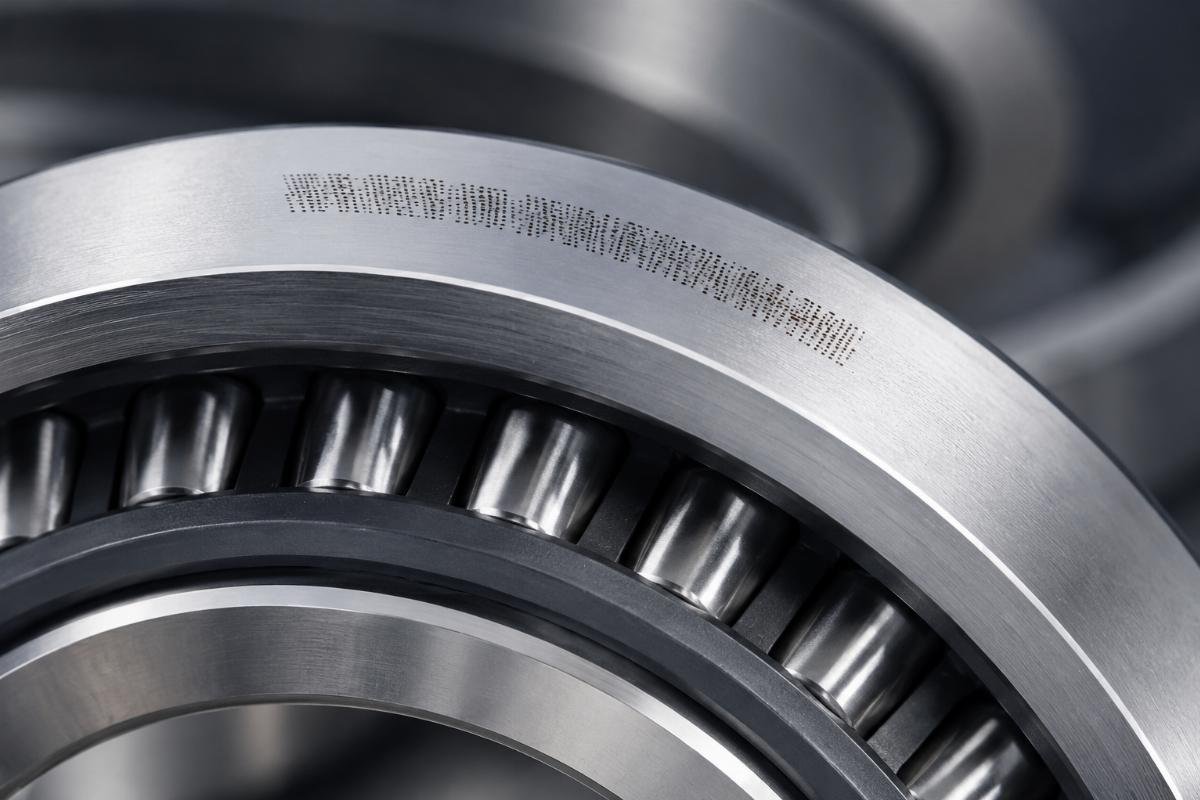
First, check the laser code on the inner ring. Genuine NSK bearings carry a laser-etched code that includes batch and traceability information. The etching is clean, sharp, and consistent across units in the same batch. Counterfeit codes often appear blurred, uneven in depth, or use a font that does not match the brand’s standard. [NEED_CITE: NSK anti-counterfeit laser code format specification]
Second, request the authorization chain. This means the supplier’s authorization certificate from NSK, the certificate’s validity period, and the named entity matching the invoicing company. If the supplier says "we buy from an authorized dealer," ask for that dealer’s authorization as well. A closed chain leaves no gap.
Third, cross-check the certificate of origin. The issuing authority must be a recognized chamber of commerce or government body. The HS code on the document must correspond to the bearing category being shipped. I have seen documents where the HS code listed "general steel parts" instead of the correct rolling bearing code—a mismatch that customs officers in importing countries flag immediately.
A Latin American importer once asked me to review a shipment of NSK tapered roller bearings. The supplier provided a certificate of origin, but the issuing entity was a private consulting firm, not a recognized chamber. The HS code on the document pointed to a different product category entirely. The importer’s customs broker refused to clear the goods. The supplier could not produce a corrected document within a reasonable timeframe, and the cargo sat in port accumulating storage fees. [NEED_CITE: certificate of origin issuing authority requirements for bearing imports]
Which NSK Bearing Models Are Most Counterfeited and How to Avoid Them?
Deep groove ball bearings in the 6200 and 6300 series—especially 6205, 6206, and 6305—are the most frequently counterfeited models because of their universal application volume across motors, pumps, and conveyor systems.
These sizes appear in everything from small industrial motors to agricultural machinery. The demand is enormous, the unit price is moderate, and the visual differences between genuine and fake units are subtle enough to fool untrained inspection. Counterfeit operations target exactly this combination: high volume, moderate value, low visual detection rate.
When sourcing these models through a buy NSK bearing factory direct wholesale supplier channel, the verification intensity must increase proportionally. I recommend a three-point check for every batch.
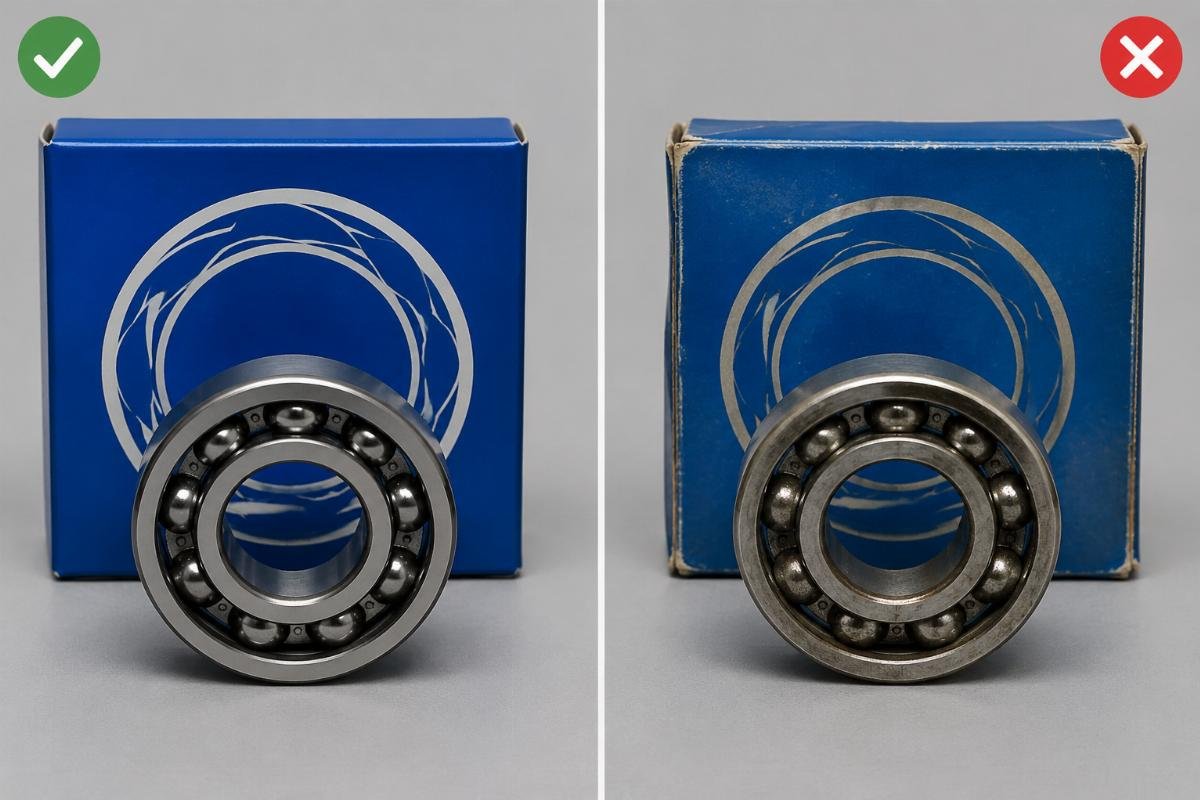
The first point is packaging consistency. Genuine NSK packaging uses specific color tones, font weights, and logo proportions that remain consistent across production periods. Counterfeit cartons often show slight color shifts or logo proportions that are close but not exact. Side-by-side comparison with a known genuine unit reveals the difference immediately.
The second point is inner ring marking. Beyond the laser code, genuine bearings carry the brand name, model number, and origin marking on the inner ring. The font, spacing, and depth are controlled. Counterfeit markings often use a different font or show uneven engraving depth.
The third point is rotational feel. Genuine NSK deep groove ball bearings in these sizes rotate with smooth, consistent resistance. Counterfeit units often show roughness, uneven drag, or audible noise at low speed. This check requires experience, but any buyer handling these models regularly develops the sensitivity quickly.
An African MRO operator once received a batch of 6206 bearings from a new supplier. The packaging looked acceptable at first glance. But when the maintenance team installed several units on conveyor motors, vibration levels rose noticeably within days. The team pulled the bearings out, and the inner ring laser codes were blurred beyond readability. The supplier had no explanation and no replacement stock. The downtime cost far exceeded the price difference the "bargain" had offered. [NEED_CITE: failure rate comparison between genuine and counterfeit deep groove ball bearings in industrial applications]
How Does Cross-Reference Work When Switching Brands?
Dimensional interchange does not equal performance equivalence—cross-reference must cover load rating, internal clearance group, and cage material, not just bore and outside diameter.
Buyers often approach cross-reference with a simple assumption: if the bore, outside diameter, and width match, the bearing is interchangeable. This assumption causes field failures. Different brands design internal geometry, heat treatment profiles, and cage structures differently, even when external dimensions conform to the same ISO standard.
When a buyer needs to cross-reference from one brand to another—say, from an SKF designation to an NSK equivalent, or from an FAG code to a NSK match—the process must follow a structured sequence.
First, confirm the basic dimensions match the ISO standard for that series. This is the baseline.
Second, verify the load rating. Dynamic and static load ratings may differ between brands for the same external size, depending on internal geometry and material treatment. A bearing with a lower load rating will show reduced service life under the same operating conditions. [NEED_CITE: ISO 281 bearing load rating and service life calculation standard]
Third, check the internal clearance group. Bearings are produced in clearance groups such as C2, C3, C4, and C5. A bearing specified with C3 clearance will behave differently under thermal expansion than one with standard clearance. Substituting without matching the clearance group risks premature failure in high-temperature applications.
Fourth, confirm the cage material and design. Pressed steel cages, machined brass cages, and polymer cages each suit different speed, temperature, and lubrication conditions. A substitution that changes the cage material without adjusting the application parameters can lead to cage failure.
A European equipment rebuild shop once needed to replace a batch of bearings on a gearbox where the original specification called for a particular brand’s tapered roller bearing with specific clearance. They sourced a cross-reference that matched the dimensions but not the clearance group. The replacement bearings ran hotter than expected, and the gearbox required teardown within months. The cost of the teardown and downtime dwarfed the original bearing cost. [NEED_CITE: bearing internal clearance group selection guidelines per ISO 5753]
| Cross-Reference Check | Dimensional Match Only | Full Performance Match |
|---|---|---|
| Bore, OD, width | Confirmed | Confirmed |
| Load rating alignment | Not checked | Verified |
| Clearance group match | Assumed standard | Confirmed to spec |
| Cage material and type | Not checked | Matched to application |
| Origin documentation | Not provided | Certified |

What Documentation Should You Request from Suppliers?
A certificate of origin, an authorization letter from the brand, and a batch inspection report form the minimum documentation floor for genuine bearing procurement.
Documentation is not paperwork for paperwork’s sake. It is the evidence trail that separates a traceable, warrantable product from an untraceable liability. When you buy NSK bearing factory direct wholesale supplier channels, the documentation request should be non-negotiable.
The certificate of origin confirms where the goods were manufactured and must be issued by a recognized authority. It supports customs clearance in the importing country and serves as the first line of origin verification.
The authorization letter confirms that the supplier sits within the brand’s approved distribution network. It should name the supplier entity explicitly, state the validity period, and be traceable back to the brand’s regional or national distribution office.
The batch inspection report provides quality data for the specific production batch being shipped. It typically includes dimensional inspection results, hardness values within the standard range for bearing steel, and rotational precision measurements. This report ties the physical goods to a production batch, enabling traceability if a field issue arises later.
I once worked with a Central Asian distributor who insisted on receiving all three documents before releasing payment. The supplier initially hesitated, then provided a certificate of origin from a recognized chamber, an authorization letter that matched the invoicing entity, and a batch report showing hardness values within the standard bearing steel range. The shipment cleared customs without delay, and the distributor had full traceability for his end customers. [NEED_CITE: bearing batch inspection report content requirements per ISO 15243]
Contrast this with a case where a buyer accepted a supplier’s verbal assurance that "the goods are genuine" without requesting written documentation. The shipment arrived, the bearings looked acceptable, and installation proceeded. Within weeks, field failures appeared. The buyer had no batch report to trace the production lot, no authorization letter to escalate with the brand, and a certificate of origin that listed a generic product description. The supplier disappeared from communication. The buyer absorbed the full cost of replacement and downtime.

Conclusion
Buying NSK bearings through factory direct wholesale channels succeeds only when authorization verification, authenticity validation, and cross-reference precision replace price-chasing as the primary sourcing criteria.
The supply chain rewards buyers who treat documentation as a technical specification, not an afterthought. Laser code clarity, authorization chain closure, and clearance group matching separate reliable procurement from costly field failures. Every quotation that cannot withstand these checks is not a bargain—it is a risk waiting to arrive at your dock.
Leave a Reply